Elegoo Centauri Carbon Review
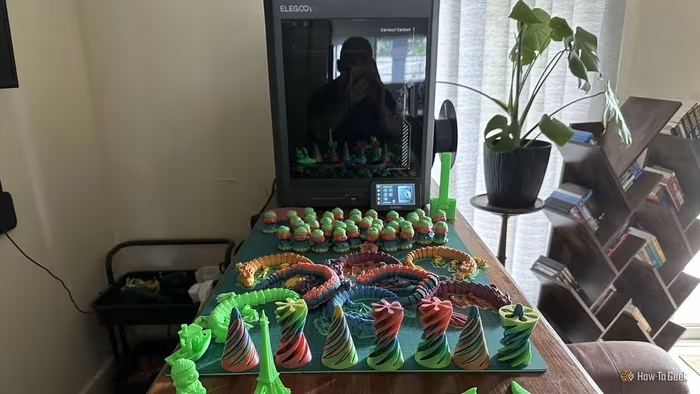
Elegoo Centauri Carbon Series
A budget-friendly, enclosed CoreXY 3D printer series offering high-speed performance and multi-color capability for hobbyists and beginners.
How This Score Is Calculated
- Sources analysed: 16 reviews
- Explicit scores: 8 sources (weighted 1.5×)
- Sentiment-only: 8 sources (weighted 1.0×)
- Split: 12 Positive · 3 Mixed · 1 Negative
- Raw weighted average: 7.8
- Formula: Σ(score × weight) ÷ Σ(weight)
- Review period: Launch and long-term assessment
- Value sources: 14 of 16 mentioned price or value
- Final score: 7.8/10 (clamped, rounded to 1 decimal)
Algorithmically calculated from source data. No manual adjustments.
- Most reviewed featurePrice (14/16)
- Most praisedPerformance-to-price ratio
- Most criticisedSoftware/Firmware bugs
- Reviewer consensus levelHigh
- Value for moneyExceptional Value (9.2/10)
The Elegoo Centauri Carbon series stands out as one of the most compelling value-propositions in the desktop 3D printing market. By combining robust CoreXY architecture with a fully enclosed design at a significantly lower price than competitors like Bambu Lab, it makes high-speed, advanced-material printing accessible to a wider audience. While users may encounter initial frustrations with software connectivity and occasional firmware bugs, the hardware quality remains high, particularly in the multi-color 'Combo' variant.
🔧 Key Specifications
Specifications sourced from reviewer mentions. Verify with manufacturer for complete details.
- Architecture: CoreXY
- Build Volume: 256mm
- Max Speed: 500 mm/s
- Enclosure: Fully enclosed steel chassis
- Multi-color: Integrated Canvas system (4-color, Combo model)
- Calibration: Full auto-calibration and self-leveling
- Connectivity: Matrix app, Local network/Cloud
- Camera: AI-integrated for monitoring/timelapse
- Touchscreen: 5-inch
💲 Price Range
₹25,000 – ₹42,000
Prices sourced from reviews. Check current retailer pricing.
📊 What Reviewers Say — Feature by Feature
8 features evaluated across 16 sources.
👍 Key Strengths
- Exceptional price-to-performance ratio
- High-speed CoreXY printing performance
- Reliable, fully enclosed build quality
- Excellent auto-calibration for beginners
- Effective 4-color multi-material system
👎 Key Weaknesses
- Inconsistent software connectivity and bugs
- Significant purge waste in multi-color
- Awkward spool holder and sensor placement
- Steep learning curve for slicer software
- No dedicated active heated chamber
💰 Value for Money Analysis
Reviewers almost universally agree that the Centauri Carbon series is a "game-changer" for budget-conscious users. At prices as low as ₹25,000, it provides core performance features that previously required spending double or triple the amount.
14 of 16 sources commented on price or value.
⚡ Where Reviewers Disagreed
The following areas saw meaningful disagreement across sources.
- Software User-Friendliness: 4 sources praised the "user-friendly" Nexprint platform and accessibility, while 5 sources heavily criticised the "buggy" and "not fully baked" software experience. This likely stems from differing levels of user expertise and firmware versions tested.
🎯 Who This Product Is For
Reviewer recommendations for different target audiences and use cases.
🛠️ Best Use Cases
- Multi-color PrintingThe Canvas system is excellent for hobbyist multicolor projects, provided the user manages purge waste.Good
- Advanced Material PrintingThe fully enclosed chamber makes it suitable for printing ABS, ASA, and abrasive materials.Great
- High-Speed PrototypingThe CoreXY kinetics support speeds up to 500mm/s, ideal for rapid iterations.Great
🔀 Alternatives Mentioned by Reviewers
Maximise this list. Include EVERY single competitor, rival, or alternative product mentioned in any of the source reviews. Do not omit any.
- Bambu Lab P1S — A direct competitor often cited as the benchmark. While significantly more expensive, it offers a more polished ecosystem and proven reliability. Choose this if you prioritize "it just works" over budget.
- Creality K1C — A direct CoreXY rival. Reviewers note it as a competent competitor, though often more expensive than the Centauri Carbon. Choose this if you prefer Creality’s ecosystem.
- Bambu Lab A1 Mini — An open-frame alternative. Often compared for its accessibility to beginners, though it lacks the enclosure required for advanced materials like ABS. Choose this if you only need small-scale, simple prints.
- Anycubic Kobra X — A lower-tier, less premium alternative. Reviewers found the Centauri Carbon to be more robust and feature-rich by comparison. Choose the Centauri Carbon if your budget allows for the step-up in quality.
- Flashforge AD5X — Mentioned for its similar design philosophy (Bowden tube feeder over the top). The Centauri Carbon is generally viewed as a more modern, competitive alternative.
- Creality K2 — A similar multi-material enclosed printer. Reviewers note the Centauri Carbon is often $100 cheaper while matching print quality.
- Prusa Research (General) — Mentioned as a higher-tier benchmark for reliability and premium support. Choose Prusa if you are a professional needing long-term stability and are willing to pay the premium.
Alternatives sourced exclusively from reviewer mentions.
🛒 Buyer's Guide
✅ Buy This If…
- You want high-speed CoreXY performance on a strict budget.
- You are a beginner who needs automated calibration and self-leveling.
- You plan to print advanced materials like ABS or ASA and need an enclosed chamber.
- You want to experiment with 4-color printing without the high cost of premium ecosystems.
❌ Skip This If…
- You are a professional who cannot tolerate occasional software bugs or connectivity drops.
- You require a dedicated, actively heated build chamber for specialized industrial-grade materials.
- You are intimidated by the need for occasional manual firmware updates or troubleshooting.
⚠️ Things to Check Before Buying
- Check for the latest firmware updates immediately upon assembly, as many early-review issues are being patched.
- Ensure you have space for the external filament system if purchasing the Combo model.
- Verify if your specific third-party filament spools are compatible with the RFID system.
📈 Sentiment Trends Over Time
Reviews span the launch of the original Centauri Carbon through the Centauri Carbon 2. The following changes were detected:
- Firmware Reliability — Early reviews of the original model highlighted significant bugs, while reviews for the Centauri Carbon 2 indicate significant improvements in firmware stability and user-friendly features.
- Price Positioning — Despite increased market competition, the printer has remained a top-tier value proposition across all review periods.
The Elegoo Centauri Carbon series is an outstanding choice for hobbyists who want high-speed, enclosed printing without the premium price tag. Its core strengths lie in its robust hardware and excellent print quality, which consistently match more expensive competitors. While the software experience remains a work in progress, the value provided is nearly impossible to beat. If you are a beginner or enthusiast looking to step into advanced material printing or multi-color projects, this machine is a top-tier contender.
Top Alternative: Bambu Lab P1S — Choose this if you prioritize software polish and long-term reliability over budget savings.
PLG_CONTENT_IMAGEGALLERY_ERROR_NO_IMAGES